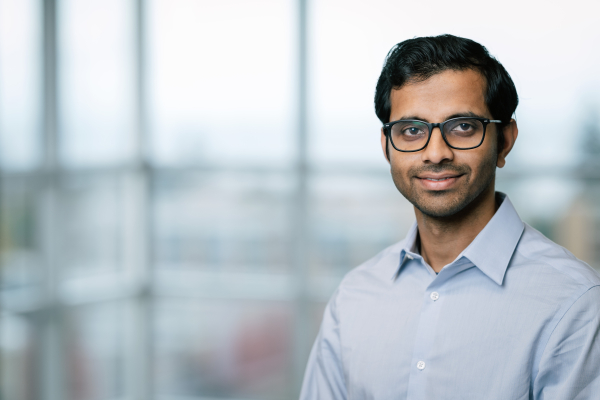
Dr. Elham Khoda brings data science education to UBC’s Department of Computer Science
New Assistant Professor of Teaching Elham Khoda, PhD, instructs courses in the Master of Data Science program
If you told Dr. Elham Khoda’s younger self that he would be teaching data science at a university one day, he wouldn’t believe you.
“I never imagined becoming a professor, let alone doing a PhD,” he says. “Nobody in my family has ever done a PhD.”
Growing up in India, Dr. Khoda was fascinated by fundamental questions about the universe, particularly how it was created millions of years ago. Following that curiosity, he studied physics at the Indian Institute of Science Educational Research, earning a combined BSc and MSc.
While his master’s degree research was in particle physics, Dr. Khoda wanted to conduct more experimental research, hoping to tackle the same questions from a different perspective. He joined UBC for his PhD in the Department of Physics and Astronomy, where he worked with thousands of other researchers on the ATLAS experiment of the Large Hadron Collider at CERN in Switzerland.
“These experiments involve millions of particle collisions in a second,” he says. “That’s a huge amount of data and we can’t store all of it.”
To process the vast amount of data quickly, he found himself having to develop machine learning algorithms to clean, filter and analyze the data — a process that was intriguing to him. His experience of being immersed in computational methods motivated him to continue his work as a postdoctoral fellow at the University of Washington, developing machine learning algorithms that can be applied to broad scientific fields.
“Fundamental questions that I started with in physics are very exciting, but there are also fundamental questions in other fields too, and many of those questions can be investigated with similar data science methods and computational tools,” Dr. Khoda says.
Prior to coming back to UBC as an Assistant Professor of Teaching, he worked as a computational data science researcher at the San Diego Supercomputer Center at the University of California, San Diego, where he managed large-scale distributed computing resources (the US National Research Platform) to support academic research and classroom instruction.
While Dr. Khoda’s academic journey took him from particle physics to computer science and data science, teaching has always been a constant. From his days at university in India to graduate school at UBC, he taught various courses as a teaching assistant, ranging from first year to fourth year classes.
“I would always choose a different course to teach each year to learn about all the different courses and how to teach them,” says Dr. Khoda.
He continued teaching during his postdoctoral fellowship, organizing workshops and short courses on machine learning and data science. For two years in a row, he helped design a machine learning training program at the Lawrence Berkeley National Lab, which introduced the foundational concepts of machine learning to graduate students and researchers.
For Dr. Khoda, teaching gives him an opportunity to relearn concepts in a different way. In particular, he’s excited about the challenges of teaching students from a broad range of backgrounds in UBC’s Master of Data Science Program.
“There’s a bit of a challenge in designing courses, so I really like that aspect of thinking about concepts again from scratch,” he says. “It’s important to make the course material accessible for students, whether or not they come from a computational background. I hope to help them understand data science so they can make new data-driven discoveries in their fields.”