Complexity of Computation: CPSC506
2010 Winter Term 1


This course covers a core of topics in complexity theory, together with a sample of recent results. The core includes the standard framework of machine-based complexity: models for computers, complexity classes and hierarchy theorems, reductions and completeness, a tour of the most common complexity classes, such as P, NP, PSPACE etc., together with parallel and probabilistic computer models and their associated complexity classes. The recent results will be chosen according to the interests of the students and instructor.

The 2005 website for CPSC 506 is here.

Place and Time
11:00-12:30 MW
201 DMP

Instructor
Anne Condon
Office: X539 CS
Phone: 822-8175
Office Hours:
3:00 - 4:00 Tuesdays
(or by appointment)

Resources

Computational Complexity
by C. H. Papadimitriou
Addison-Wesley, 1994
Available in the reading room

Computational Complexity
by S. Arora and B. Barak, Cambridge University Press, 2009
Draft available on-line
Contains links to on-line graduate notes

Godel's Lost Letter and P=NP
Lipton's blog

Course Schedule

Date Resources
Wed, Sep 8 Welcome!

Topic: Turing Machines
Slides, Turing machine handout
Reading: Arora and Barak Sections 1.1, 1.2.
Be able to write down TM definitions and definitions of time bounded language acceptance, function computation, time constructibility from memory. Understand statements and proofs of Claims in Section 1.2.2 (robustness).

Mon, Sep 13 Topic: Turing Machines continued
Slides, Homework 1
Reading: Arora and Barak Sections 1.3,1.4
Be able to describe what is a universal Turing machine, define the Halting Problem and prove that it is uncomputable, write down definition of the class P. Understand statement of Hennie and Stearn's theorem and the proof of the relaxed variant given on p 22.
Wed, Sep 15 Topic: P and NP, nondeterministic TMs, reductions
Sample in-class exercise.
Slides
Reading: Arora and Barak Sections 1.5,2.1,2.2
Be able to define the classes P and NP, a polynomial-time (Karp) reduction and what it means for a language to be NP-complete or NP-hard. Understand how reductions are used to establish NP-completeness results.

Mon, Sep 20 Topic: The Cook-Levin Theorem, more reductions
Slides, Cook-Levin Theorem handout
Reading: Arora and Barak Sections 2.2, 2.3,2.4
Be able to define what is a nondeterministic TM (NTM), what it means for a NTM to accept a language, and the definition of NP in terms of NTMs. Understand the statement and proof of the Cook-Levin theorem. Develop more skills at doing polynomial-time reductions.
Wed, Sep 22 Topic: co-NP, EXP, NEXP
Slides
See also David Johnson's 2007 NP-completeness Column
In-class exercise.
Reading: Arora and Barak Sections 2.5,2.6
Be able to define the classes co-NP, EXP, and NEXP, describe some complete problems in these classes, and problems in NP &cap co-NP that are not known to be in P.

Mon, Sep 27 Topic: Time Hierarchy Theorems, Oracle TMs
Slides, Time Hierarchy Theorem handout
Reading: Arora and Barak Sections 3.1,3.4,3.5
Be able to state the deterministic Time Hierarchy Theorem and Ladner's Theorem. Understand the proof of the deterministic Time Hierarchy Theorem. Know what an Oracle TM is.
Student presentation: Robert Tseng on NP-hard problems pertaining to robustness of sensor networks
Wed, Sep 29 Topic: Oracle TMs and Limits of Diagonalization; Space Bounded TMs
Slides, Homework 2
Reading: Arora and Barak Sections 3.5, 4.1, 4.2
Understand the proof of the Baker, Gill and Solovay Theorem. Be able to define the space bounded complexity classes L, NL, PSPACE, NPSPACE and prove that problems are NL-complete.

Mon, Oct 4 Topic: Immerman-Szelepscényi Theorem
Reading: Arora and Barak Section 4.4
Wed, Oct 6 Topic: PSPACE-completeness, Savitch's Theorem
Guest lecture by Joel Friedman
Reading: Arora and Barak Section 4.3

Mon, Oct 11 Holiday - Canadian Thanksgiving
Wed, Oct 13 Topic: The Polynomial Time Hierarchy, Alternating TMs
Slides
Reading: Arora and Barak Sections 5.1,5.2, 5.2
Be able to define the polynomial time hierarchy and give some examples of problems that are complete for levels of the hierarchy. Be able to show that if NP=P then the polynomial time hierarchy collapses. Be able to define the polynomial time hierarchy, and PSPACE, in terms of polynomial-time alternating Turing machines.

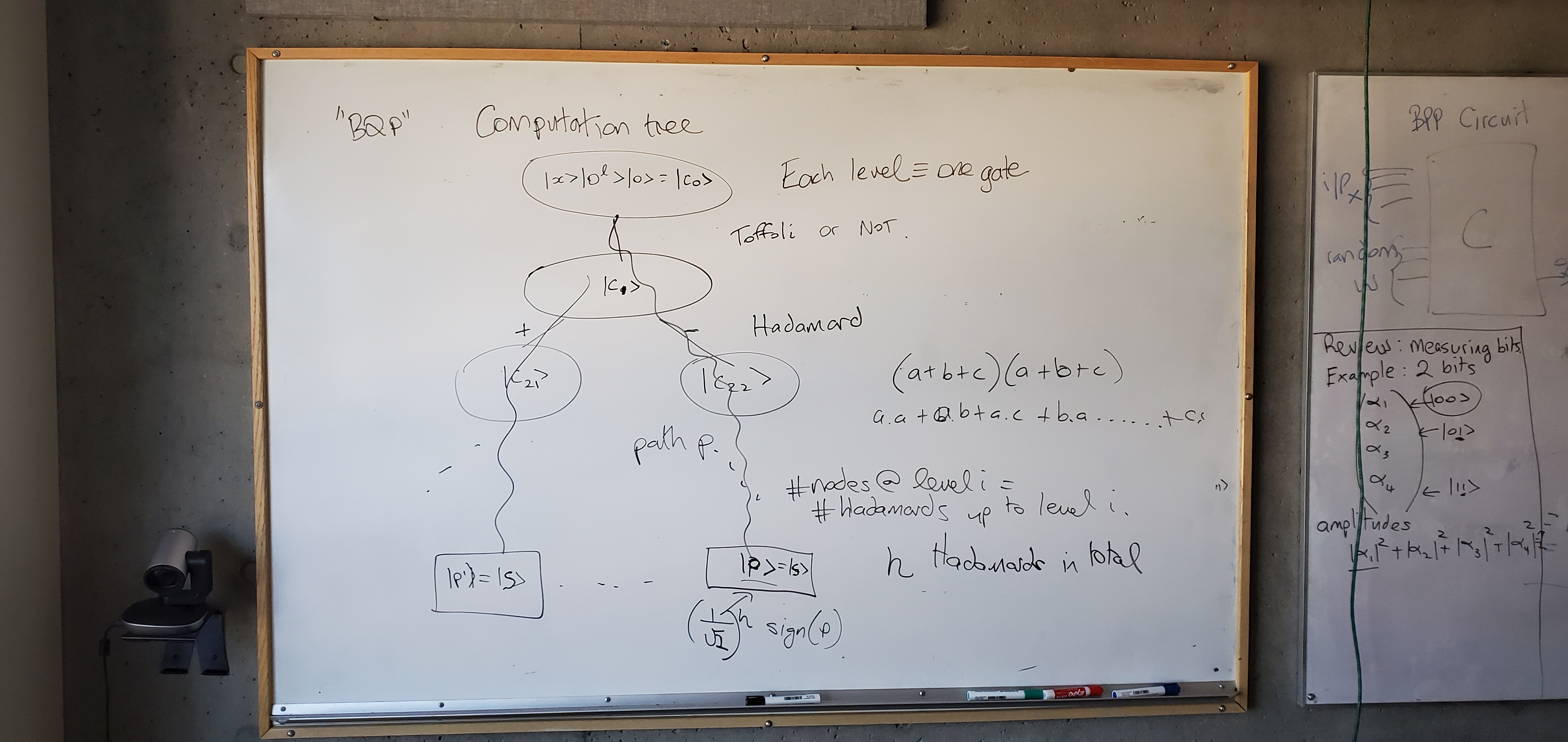
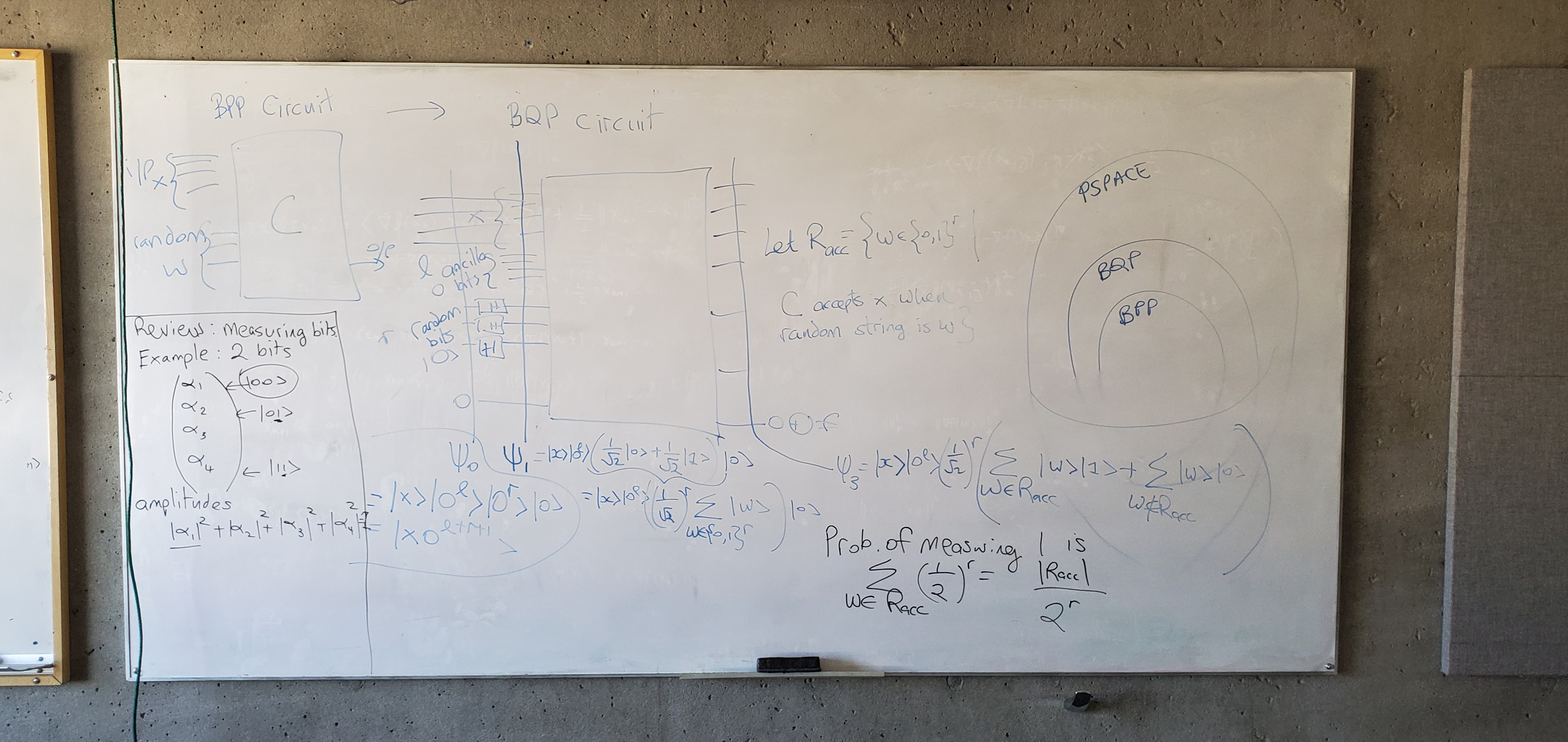
Mon, Oct 18 Topic: Randomized Computation
Slides
Reading: Arora and Barak Sections 7.1,7.2,7.3,7.4
See also Hastad's notes pages 90-91, for a nice presentation on polynomial identity testing.
Be able to define the classes BPP, RP, co-RP and ZPP, describe relationships among these classes, and describe an example of a problem for which there is an efficient probabilistic algorithm but no known deterministic algorithm.
Student presentation: Ryan Giuliani on the Complexity of GO.
Wed, Oct 20 Topic: Randomized Computation continued
Slides, Homework 3
Reading: Arora and Barak Sections 7.7,7.8
Understand the proofs of Sipser's theorem, that BPP is in the polynomial time hierarchy and the statement of Adleman's theorem, that BPP is in P/poly.

Mon, Oct 25 Topic: Randomized Computation continued
Slides, Space bounded probabilistic complexity classes handout
Reading: Arora and Barak Sections 7.8, 7.10
Be able to define space bounded probabilistic complexity classes, show RL=NL, and understand the proof that UPATH is in RLP.
Student presentation: Sam Bayless on SAT Solvers.
Wed, Oct 27 Topic: Randomized Computation continued
Slides
Reading: Handout from last class
In-class exercise.

Mon, Nov 1 Topic: Interactive Proof Systems
Slides, IP = PSPACE, Part 1
Be able to define what is an interactive proof system, and understand arithmetization of quantified Boolean formulas.
Reading project description
Wed, Nov 3 Topic: Interactive Proofs continued
Slides, IP = PSPACE, Part 2

Mon, Nov 8 Topic: Approximation Algorithms
Slides, Approximate Solutions to NP-hard Problems
Reading: Arora and Barak Sections 11.1, 11.2
Be able to describe poly-time approximation algorithms with constant factor approximation ratios for Max 3SAT, Vertex Cover and the Traveling Salesman Problem (TSP) with triangle inequality, and be able to explain why the general TSP does not have such an algorithm unless P=NP.
Wed, Nov 10 Topic: The PCP Theorem and Hardness of Approximation
Slides , Applications of the PCP Theorem to Hardness of Approximation
Understand the statement of the PCP theorem and be able to use the PCP theorem to show that Max 3SAT and Max Clique do not have polynomial time approximation algorithms with constant factor approximation ratios unless NP=P.

Mon, Nov 15 Topic: Gap-Preserving Reductions and Hardness of Approximation
Slides
Be able to use gap-preserving reductions to show hardness of approximation results for Max Independent Set and other problems.
Wed, Nov 17 Topic: Proof of a Weak Version of the PCP Theorem
Slides, Homework 4
Reading: Arora and Barak Section 11.5
Understand the proof of the theorem that PCP(poly(n),1) contains NP.
Student presentation: Bader Al-Ahmad on Energy Efficient Task Partitioning and Scheduling.
Student presentation: Kyle d'Oliveira.

Mon, Nov 22 Topic: Bio-molecular Programming
Slides
Understand how and why we might compute with DNA molecules, and what theoretical questions arise in this context.
Student presentation: Jimmy Kwa on Logical Characterization of NP.
Student presentation: Shabab Hossain.
Wed, Nov 24 Topic: Bio-molecular Programming continued
Slides
Student presentation: David Chan.
Student presentation: Hajir Roozbehani on Approximation Algorithms for Max Cut and Max 2SAT Using Semidefinite Programming.

Mon, Nov 29 Topic: Undirected ST-Connectivity is in Log-Space
Slides Part 1 , Slides Part 2 , Slides Part 3 , Slides Part 4
Project presentation: Bader Al-Ahmad, Kyle d'Oliveira, Jimmy Kwa, Robert Tseng.
Wed, Dec 1 Topic: Undirected ST-Connectivity is in Log-Space continued
Project presentation: Sam Bayless, David Chan, Ryan Giuliani, Shabab Hossain.

Mon, Dec 10 Final Exam Information